Strategic AI Investment: A CFO's Guide to High-Impact Sectors

For today's CFO, the pressure isn't just about closing the books; it's about opening new doors to growth. But historical data, the traditional bedrock of financial strategy, is an increasingly unreliable guide to a future being rewritten by AI. The critical question is no longer 'What was our performance?' but 'Where will AI create exponential value next?' This marks a strategic inflection point for finance leaders, demanding a shift from rearview-mirror reporting to forward-looking capital allocation.
Why Traditional Sector Analysis Falls Short in the AI Era
In a market defined by rapid technological disruption, historical performance has lost its predictive power. CFOs who rely on traditional financial models risk a critical misallocation of capital, channeling funds into sectors with diminishing returns while overlooking nascent, high-growth opportunities supercharged by AI. The reliance on outdated frameworks creates a strategic drag, limiting agility and surrendering competitive ground.
- Flawed Assumptions: Yesterday’s sector growth rates are poor proxies for future performance in an economy undergoing fundamental, AI-driven workflow redesign.
- Capital Risk: Investing without a clear understanding of AI's sector-specific impact profile is no longer prudent. It exposes the organization to unforeseen risks and suboptimal returns.
- Missed Opportunities: The real challenge is not merely managing costs but identifying where to strategically invest for exponential growth. This requires a new lens for evaluating the corporate portfolio.
A New Framework: Pinpointing High-Impact AI Opportunities
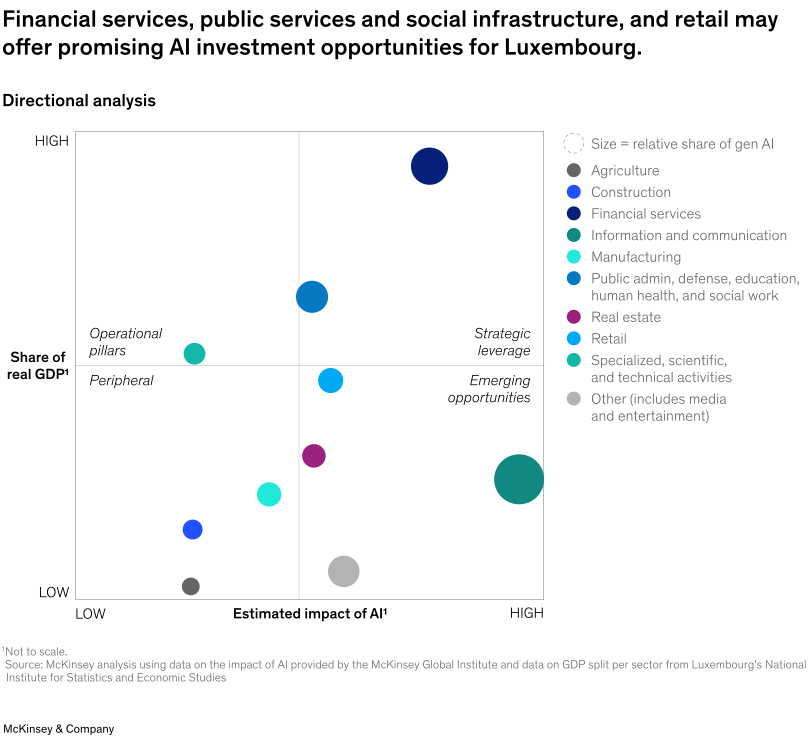
To navigate this new landscape, a more sophisticated, boardroom-ready framework is required. A modern approach evaluates sectors not on past performance alone, but on two forward-looking axes: their current economic contribution (share of GDP) and their susceptibility to AI-driven transformation. This dual-axis analysis allows for a more rigorous classification of investment opportunities, moving beyond intuition to a data-driven action plan.
This methodology sorts sectors into four distinct categories: mature pillars, emerging disruptors, operational mainstays, and—most critically for strategic planning—leverage points. Focusing investment in the "strategic leverage" quadrant, where high GDP share and high potential for AI impact intersect, provides the clearest path to significant, defensible returns and measurable value creation.
Translating Data into Dollars: The CFO’s Role in Strategic AI Investment
The analysis presented in the exhibit is more than an academic exercise; it is a direct call to action for the finance leader. As the data shows, sectors like financial services are primed for transformation. The CFO must champion these insights, translating the potential of AI into a compelling financial narrative centered on ROI, risk mitigation, and sustainable competitive advantage.
- Build a Defensible Business Case: Move beyond abstract potential by modeling the direct EBIT impact of AI adoption. Quantify improvements in operational efficiency, revenue growth enabled by new capabilities, and margin expansion within these high-potential sectors.
- Define a Clear ROI Timeline: Present a phased investment roadmap that delivers demonstrable returns in the near term, building momentum and securing organizational buy-in for a longer-term transformation.
- Reframe the Narrative: This is not an IT expenditure. It is a strategic imperative for securing future market leadership. The CFO's role is to frame the investment as the essential next step in the evolution of the business.
From Cost Center to Value Engine: Leading with a Forward-Looking Financial Strategy
By leveraging AI for strategic forecasting and investment analysis, the finance team can finally transition from hindsight to foresight. This evolution is crucial. It moves the finance function from a historical scorekeeper to a proactive, strategic partner to the board and CEO. Adopting this framework is the first step in that transformation. It equips the CFO to provide authoritative, data-driven guidance, solidifying their role not just as a steward of capital, but as a key architect of the company's future.


