The Accelerated Economic Imperative of Generative AI for Growth-Focused CEOs

Your five-year strategic plan is already obsolete. While you were planning for the future, Generative AI just collapsed it into the present. For growth-focused CEOs, this isn't a distant trend—it's an immediate economic imperative that redefines the speed of competition and the very foundation of scalable growth. This is a strategic inflection point that demands immediate attention from the top.
Why Your Strategic Timeline Just Evaporated
The traditional 3-5 year strategic plan is built on the assumption of linear progress, a predictable evolution of markets and capabilities. That assumption is now a liability. Generative AI introduces an exponential curve, warping the timeline for innovation and making past performance an unreliable predictor of future competition. What was once on the horizon for the next decade is now a boardroom-ready reality.
- Linear Assumptions vs. Exponential Reality: Your operational models, hiring plans, and market strategies are likely based on a pace of change that no longer exists.
- The Obsolescence of Historical Data: While valuable for context, historical performance data cannot fully model the disruptive potential that AI brings to your competitors' capabilities.
The New Pace of Competition: AI Isn't a Future Goal, It's Today's Reality
Expert forecasts for AI achieving human-level performance have been drastically shortened. Capabilities in areas like natural-language understanding, once projected for 2027 or beyond, became a reality in 2023. This is not merely about faster chatbots or better marketing copy; it represents the arrival of AI co-pilots capable of complex analysis, code generation, and strategic modeling. Competitors leveraging these tools operate at a fundamentally different speed, accelerating their decision-making cycles while others are still gathering data.
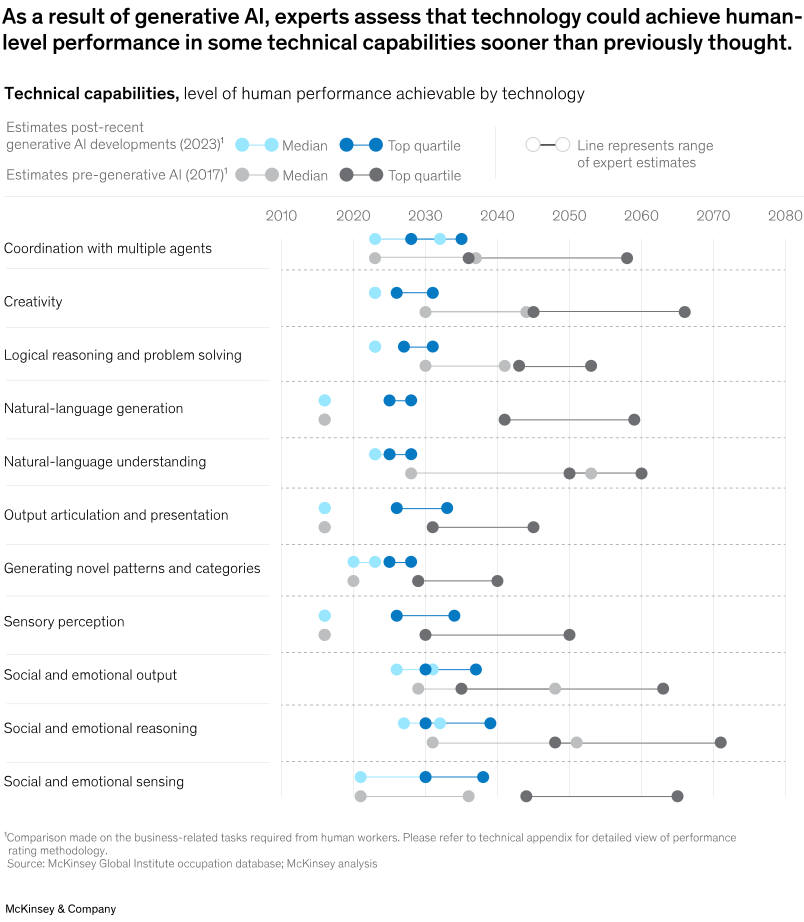
The implications of this collapsed timeline are profound. As the exhibit demonstrates, the gap between median and top-quartile human performance is now being closed by technology years ahead of schedule. This isn't a forecast; it's a statement of the current landscape. For a CEO, this data presents a critical question: is your organization structured to compete on this new, accelerated timeline?
The CEO's Blind Spot: How Back-Office Drag Inhibits Front-Office Growth
While you focus on market strategy and front-office execution, a hidden anchor may be creating significant operational drag. Manual, inefficient back-office processes, particularly within the finance function, directly inhibit your ability to move at the speed AI demands. This drag is not a minor inconvenience; it has a direct EBIT impact by inflating SG&A costs and delaying critical decisions.
This inefficiency manifests as a lack of real-time visibility into cash flow, delayed month-end closes that hinder strategic planning, and an inability to scale operations without a linear increase in headcount. While your competitors are leveraging AI for predictive insights, your team may be stuck reconciling invoices, creating a bottleneck that ripples through the entire organization.
From Guesswork to Growth Engine: Harnessing AI for Decisive Financial Leadership
The imperative is to transform the finance function from a historical scorekeeper into a predictive, strategic engine for growth. A thoughtful workflow redesign, powered by AI, provides the forward-looking visibility required for decisive leadership. This isn't about replacing people; it's about empowering your most critical thinkers with the tools to focus on measurable value creation.
An AI-powered finance function delivers:
- Boardroom-Ready Insights: On-demand, reliable data for confident capital allocation, M&A analysis, and strategic pivots.
- Scalable Operations: Growth in revenue no longer requires a proportional increase in overhead, protecting margins and enabling agile expansion.
- Embedded Compliance Guardrails: Automation mitigates the risk of human error and ensures financial operations adhere to regulatory frameworks from the start.
Your Next Move: Seizing the Accelerated Advantage
The timeline for AI adoption has collapsed. Waiting is no longer a viable strategy; it is a decision to fall behind. The competitive advantages being secured today by early adopters will compound, making it exponentially harder to catch up.
Your next move is not to launch a massive, enterprise-wide AI initiative. It is to start with a focused action plan. Task your CFO with a strategic review using a single, critical question: "What is our roadmap to automate our core financial operations, and what is the measurable cost of inaction over the next 12 months?"
This question shifts the focus from technology as a cost center to workflow redesign as a strategic investment in speed and resilience. It is the first step toward building an organization that can thrive at the new pace of business.


