The Strategic CFO's Guide: Unlocking Generative AI's High-Skill Productivity Frontier in Finance

As a CFO, you are tasked with architecting the financial future of the enterprise. Yet, the majority of your team's bandwidth is consumed by reporting on the past. Traditional automation promised a reprieve, but its impact has been largely confined to the fringes of your operation—addressing routine, low-value tasks. What if the next strategic inflection point in technology was designed not for your junior staff, but to amplify the strategic capabilities of your most senior talent?
The Productivity Paradox: Why AI Now Targets Your Top Talent
For decades, the automation playbook has been consistent and predictable. Technology was deployed to handle repetitive, low-skill tasks, freeing up human capital for more complex work. This model targeted the base of the organizational pyramid, aiming for incremental efficiency gains. However, this approach has reached a point of diminishing returns, leaving the most critical, high-skill functions largely untouched.
Generative AI represents a fundamental paradigm shift. Its core strength lies not in replicating simple rules but in understanding context, synthesizing vast amounts of information, and augmenting complex decision-making processes. This makes it a force multiplier for the most experienced—and expensive—members of your finance team. It is a tool designed to enhance judgment, not merely replace keystrokes.
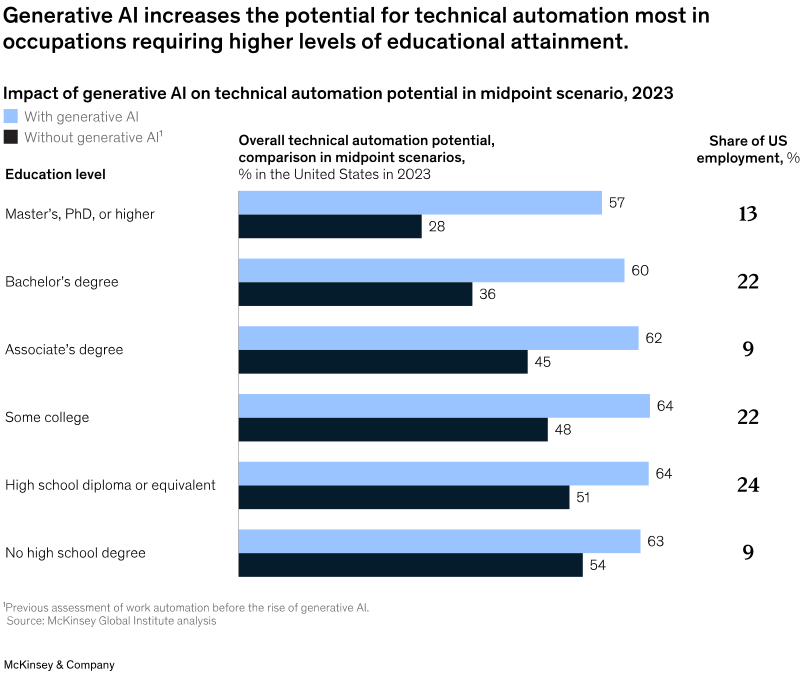
The implications of this data for the modern finance team are profound. The primary ROI of Generative AI is not found in automating accounts payable but in elevating the analytical power of senior financial planners and risk managers. This technology provides the leverage to transform your most valuable human assets from high-level operators into true strategic advisors, directly impacting the quality and speed of executive decision-making.
From Cost Center to Strategic Engine: 3 High-Value Functions Reimagined
Applying this new model requires a workflow redesign in the finance function’s most critical areas.
- 1. Forecasting and Scenario Planning: From Reactive Reporting to Proactive Strategy.
Manual forecasting is slow and backward-looking, creating a drag on strategic agility. Generative AI agents can process thousands of internal and external data points—from sales pipelines to macroeconomic indicators—to build dynamic, multi-variable scenario models in minutes, not weeks. This allows leadership to test hypotheses and quantify the EBIT impact of potential decisions, turning the finance function into a proactive driver of strategy. - 2. Intelligent Compliance and Risk Management: Mitigating Threats Before They Emerge.
Regulatory complexity is an ever-present threat to the enterprise. Instead of periodic manual reviews, Generative AI can continuously scan new regulatory publications (e.g., IRAS updates) and cross-reference them against internal operational data. This creates intelligent compliance guardrails, flagging potential non-compliance issues before they become material risks and providing a clear action plan for risk mitigation. - 3. Board-Level Reporting: Crafting a Compelling Financial Narrative, Instantly.
CFOs spend an inordinate amount of time translating raw financial data into a coherent, forward-looking narrative for the board. Generative AI can synthesize performance data, forecast models, and market analysis to draft boardroom-ready commentary that highlights key insights and strategic considerations. This frees the CFO to focus on delivering high-level counsel, not on crafting PowerPoint slides.
The CFO's Playbook for Deploying Generative AI for Strategic Gain
Successfully harnessing this technology requires a deliberate and strategic approach, not a sprawling, unfocused initiative.
- Start with a Strategic Pilot, Not a Moonshot.
Focus on a single, high-impact process where improvement can be clearly measured, such as forecast accuracy or the speed of monthly closing. A tightly scoped pilot with a clear ROI timeline (e.g., 90 days) will demonstrate measurable value creation and build the business case for broader implementation. - Prioritize Data Integrity as a Non-Negotiable Foundation.
The output of any AI is only as reliable as its input data. Before deployment, ensure your data architecture is clean, secure, and standardized. Effective AI implementation depends on a bedrock of data governance, making it the critical first step in any workflow redesign. - Upskill Your A-Players to Build a Truly Augmented Team.
The goal is not to replace your best people, but to make them more powerful. Invest in training your senior talent to become AI Agent Architects—experts who can define, direct, and validate the work of AI systems. This transforms your team’s capabilities and builds a sustainable competitive advantage.
Conclusion: The Future of Finance Is Not Automated, It's Augmented
The narrative of automation as a tool for simple task replacement is now outdated. For the strategic CFO, Generative AI offers something far more valuable: the opportunity to augment the intelligence and judgment of your most critical team members. By focusing on high-skill applications, you can finally shift the finance function's center of gravity from historical reporting to forward-looking strategy, cementing your role as a primary driver of enterprise value.


