The CEO's AI Blueprint: 6 Capabilities for Enterprise Transformation & Competitive Growth

Strategic decisions are made in moments, but most financial reports still speak in months. For a growth-focused CEO, this data lag isn't just an inconvenience—it's a fundamental barrier to outpacing the competition. The difference between market leader and laggard now hinges on moving from rearview reporting to a predictive, AI-powered growth engine. This is the strategic inflection point where leadership must pivot from intuition-based wagers to data-validated strategy.
The Strategic Imperative: Moving from Guesswork to a Growth Engine
The pressure to make high-stakes capital allocation, market entry, and operational scaling decisions is immense. Making them with lagging financial data is a high-risk proposition that erodes competitive advantage. The core challenge isn't a lack of ambition; it's the operational drag of outdated workflows that fail to provide real-time visibility into the metrics that matter. AI, in this context, is not a technology project to be delegated. It is a strategic capability that, when properly implemented, transforms the finance function from a cost center into a center for measurable value creation. The objective is to engineer a proactive, predictive financial model that empowers confident, decisive leadership.
The 6 Capabilities for a Resilient, AI-Powered Enterprise
Successful AI transformation is not about acquiring a single piece of software; it demands a holistic 'rewiring' of the organization across its people, processes, and technology. This requires a clear blueprint to de-risk the investment and ensure it delivers enterprise value. Based on extensive analysis of successful transformations, a clear framework emerges, detailing the core capabilities required to build a truly intelligent and resilient enterprise.
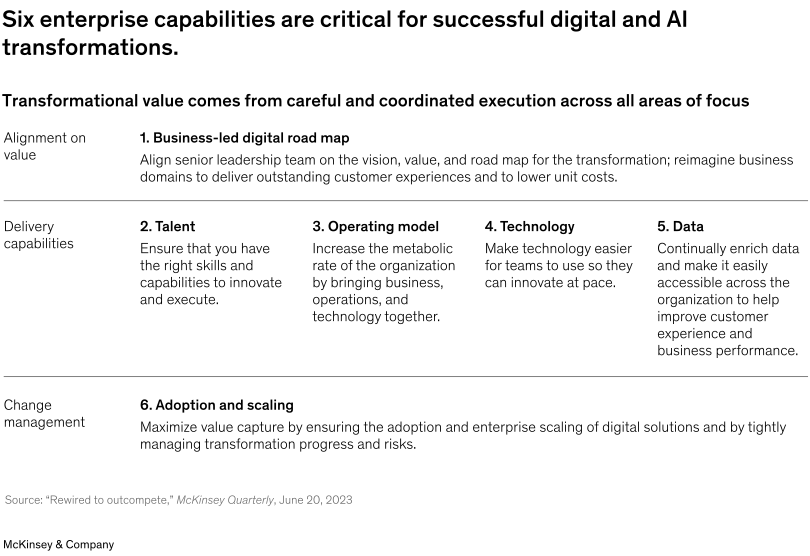
This framework provides a structured action plan for CEOs, breaking down a complex transformation into manageable, interconnected workstreams. It moves the conversation from abstract potential to a concrete operational plan, focusing on the three critical phases of any successful strategic initiative: aligning on value, building the delivery engine, and driving adoption.
Aligning on Value: The North Star of Your AI Strategy
The first and most critical capability is a business-led digital roadmap. Any AI initiative that does not originate from a clear business objective is destined to become a costly science experiment. The CEO’s primary role is to ensure that every investment in technology is inextricably linked to measurable business outcomes—be it market share growth, margin improvement, operational scalability, or risk mitigation. This requires championing a unified vision at the board level, securing leadership alignment on the 'why' behind the investment, and establishing clear KPIs to measure progress. This is the foundational step that ensures the entire organization is rowing in the same direction.
Building the Engine: Your Core Delivery Capabilities
With the strategic 'why' established, the focus shifts to the 'how'. This requires building a robust delivery engine, which encompasses talent, a new operating model, and a modernized technology and data architecture. From a CEO’s perspective, this is not about micromanaging technical specifics. It is about ensuring the organizational structure is fit for purpose. Talent development is not just about hiring data scientists, but about empowering existing finance teams with the tools and skills to leverage AI for higher-value analysis. Similarly, technology and data architecture must be addressed to create a 'single source of truth.' This eliminates the data silos and workflow bottlenecks that currently hinder growth, providing the compliance guardrails necessary for confident execution.
Driving Adoption: From Blueprint to Bottom-Line Impact
A flawless blueprint is meaningless without disciplined execution and enterprise-wide adoption. The final capability, adoption and scaling, is where strategy translates into bottom-line impact. The most effective approach is to secure quick, high-impact wins within the first 90 days. Demonstrating a clear ROI on a contained initiative builds the political capital and organizational momentum required for a broader rollout. Ultimately, the CEO must lead the cultural shift, championing a move toward data-driven decision-making from the top down. By doing so, they not only implement a new technology but also fundamentally rewire the organization’s operating model, empowering the finance team to fulfill its role as a true strategic partner in driving competitive growth.


