Strategic AI Investment: A CFO's Framework for High-Impact Opportunities

The board doesn't just want to know where the company has been; they want to know where you're taking it. But how do you shift from rearview mirror reporting to forward-looking strategy when you're buried in historical data? The strategic inflection point for today’s CFO lies not just in adopting AI, but in architecting a disciplined, defensible investment plan that targets measurable value creation.
The CFO's Dilemma: Drowning in Data, Starving for Insight
The modern finance function faces a fundamental conflict. On one hand, there is the operational mandate for meticulous historical reporting. On the other, there is the board’s escalating demand for strategic foresight. This creates a challenging dynamic for even the most effective finance leaders.
- The Reporting Treadmill: Analysis shows that finance teams can spend up to 80% of their time on manual, backward-looking tasks like data compilation and reconciliation. This operational drag consumes resources that should be allocated to forward-looking analysis and strategic planning.
- The Board's Demand for Foresight: Boardroom conversations have moved beyond last quarter's results. Directors now expect predictive insights that can inform capital allocation, identify market opportunities, and mitigate emerging risks. The CFO is expected to be the primary source of this data-driven guidance.
- The Risk of Inaction: In this environment, failing to invest in modernizing the finance function is not a passive choice; it's an active acceptance of competitive disadvantage. The risks include falling behind more agile competitors, eroding margins due to operational inefficiencies, and failing to meet evolving compliance standards, which introduces significant financial and reputational liability.
A Framework for Strategic AI Allocation
The market is saturated with claims about AI's transformative potential. A CFO’s primary role is to cut through this noise and pinpoint initiatives with the highest probability of delivering a clear, quantifiable EBIT impact. This requires a structured framework for evaluating and prioritizing opportunities, moving beyond speculative hype to a methodical, portfolio-based approach.
- Moving Beyond the Hype: A successful AI strategy is not about chasing every new technology. It is about a disciplined workflow redesign that targets specific financial and operational outcomes. The objective is to build a defensible business case for every dollar invested.
- Introducing the Investment Matrix: To achieve this, we can use an investment matrix that plots opportunities on two critical axes: their strategic importance to the business (e.g., contribution to revenue or GDP) and the potential for AI-driven transformation. This provides a clear, data-informed action plan for capital allocation.
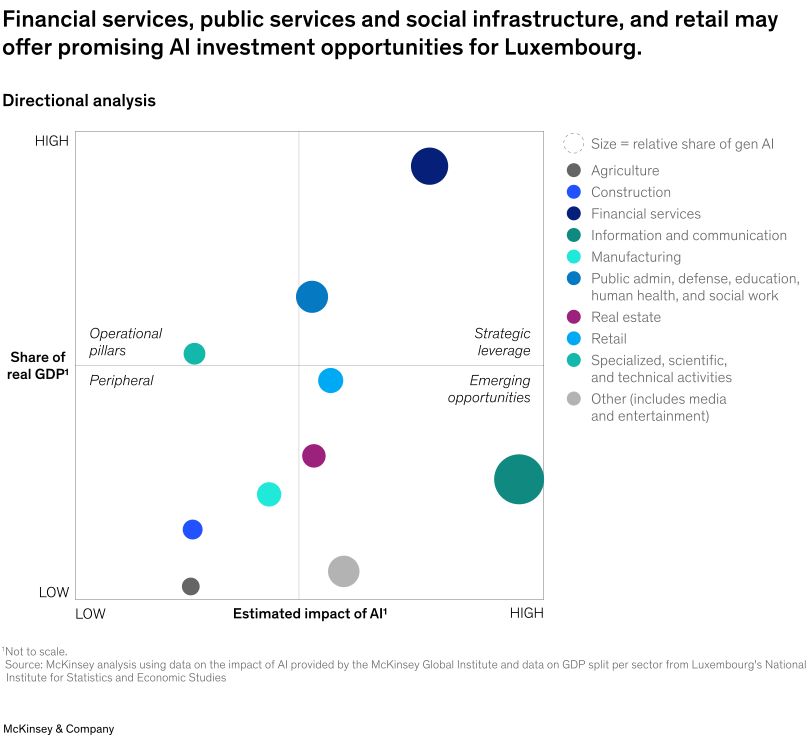
Decoding the Matrix: Where to Place Your Bets
While the exhibit analyzes national economic sectors, its methodology provides a powerful framework for any CFO. By mapping your own business units or functions onto this matrix, you can identify where to allocate resources for maximum impact. The four quadrants represent distinct strategic approaches:
- Strategic Leverage (High Impact, High GDP Share): These are your core business operations—the primary drivers of revenue and value. For these areas, AI investment should focus on building a sustainable competitive moat. The goal is to optimize core processes, enhance forecast accuracy, and maximize profitability to fortify your market leadership.
- Emerging Opportunities (High Impact, Low GDP Share): These represent potential future growth engines. While smaller in scale today, their high potential for AI-driven transformation marks them as critical areas for innovation. These are calculated, strategic investments designed to capture new market segments or redefine your value proposition.
- Operational Pillars (Low Impact, High GDP Share): These are essential, high-contribution areas that are less susceptible to AI-driven disruption. For these pillars, the investment thesis for AI should be centered on efficiency, cost reduction, and risk mitigation—not top-line growth. Think automated reconciliation, enhanced compliance checks, and streamlined reporting.
From Framework to Financials: Building the Business Case for AI
A strategic framework is only valuable if it translates into a boardroom-ready business case. Connecting AI initiatives to core financial metrics is essential for securing buy-in and measuring success.
- Modeling the ROI: A credible financial model for AI should go beyond soft benefits. Focus on hard metrics like improved forecast accuracy (leading to better inventory and capital management), reduced SG&A from automation, and faster closing cycles that accelerate decision-making. The ROI timeline should be clear and defensible.
- De-Risking Your Investment: A phased adoption, guided by the matrix, is a powerful risk mitigation tool. Start with a high-impact project in an "Operational Pillar" to demonstrate quick wins and build institutional confidence. This proves the value of the technology while providing valuable implementation learnings.
- AI as a Compliance Co-Pilot: For a CFO, control is non-negotiable. Modern AI platforms can be engineered with compliance guardrails from the ground up. This transforms AI from a potential risk into a co-pilot that automates regulatory checks and adapts to evolving standards, ensuring unimpeachable financial integrity.
Conclusion: Transforming Finance into a Strategic Partner
The pressure on CFOs to evolve from historical scorekeepers to forward-looking strategists will only intensify. Meeting this demand requires more than new technology; it requires a new mindset. It’s about becoming the AI Agent Architect for the finance function.
- The CFO as AI Champion: By using a strategic framework like the investment matrix, the CFO can lead the AI conversation with confidence. It allows you to transform the finance function from a perceived cost center into a proactive, value-creating engine that powers the entire organization.
- Your Next Move: The path forward is clear. Challenge your leadership team to map your company's business units onto this matrix. This simple, powerful exercise will immediately illuminate your highest-priority AI investment opportunities and provide the foundation for your action plan.


