Navigating RegTech's Future: Strategic Insights for CFOs on Compliance & Risk Mitigation

The board doesn't want to hear about compliance; they want to see a strategic advantage. As regulatory complexity grows, leading CFOs are no longer asking, "Are we compliant?" but "How can our compliance strategy drive growth and mitigate risk before it emerges?" This shift marks a strategic inflection point for the finance function, moving it from a reactive, cost-based model to a proactive engine for value creation.
From Reactive to Proactive: Why RegTech is the CFO's New Strategic Imperative
The operational landscape for CFOs is in a state of constant flux. The growing complexity of global and local regulations, from IRAS mandates to the implementation of InvoiceNow in Singapore, is transforming the finance function from a predictable overhead into a dynamic source of risk. Teams tethered to manual processes and historical reporting are finding themselves perpetually on the back foot, unable to deliver the forward-looking insights the business requires.
This is where Regulatory Technology (RegTech) emerges not as a mere automation tool, but as a foundational component of a modern finance strategy. For the forward-thinking CFO, RegTech provides the compliance guardrails necessary to navigate uncertainty with confidence. It redefines the operational model by embedding control directly into workflows, unlocking real-time data that sharpens forecasting accuracy and hardens risk mitigation frameworks.
Mapping the Global RegTech Landscape: Where to Find Innovation
To leverage RegTech effectively, a CFO must first understand the market's structure. A clear view of the geographic concentration of RegTech development is critical for making informed investment decisions, identifying mature solutions, and anticipating future shifts that could present either opportunities or risks.
Currently, the market is heavily dominated by providers in North America and Europe. This concentration has direct implications for solution maturity, regional specialization, and the vendor selection criteria that should be applied. While these established markets offer robust platforms, they may lack the specific focus required for navigating the nuances of disparate regulatory environments, particularly within the APAC region.
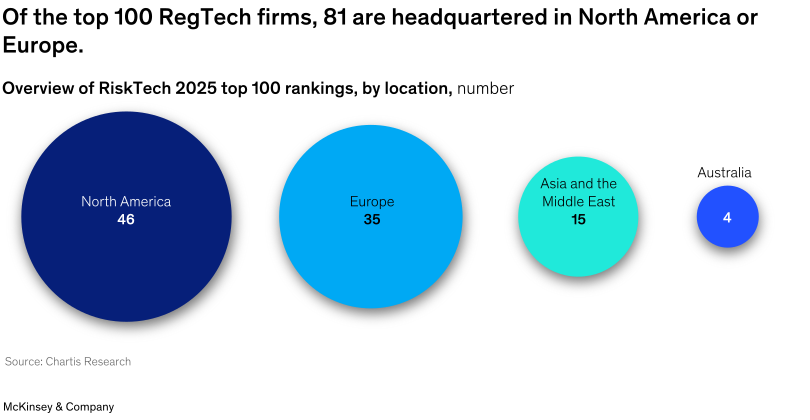
The data presented in this exhibit provides a clear directive for strategic sourcing. The concentration of 81 out of the top 100 firms in Western markets means that while these vendors offer stability and deep-seated expertise, they may not represent the leading edge of innovation for region-specific challenges. For CFOs in Asia, this requires a dual-track approach: evaluating established global players for core platform stability while actively seeking emerging innovators in APAC and the Middle East who are building solutions tailored to local regulatory demands.
Furthermore, the data signals where the next wave of disruptive growth will likely originate. The lower market penetration in regions outside of North America and Europe suggests a significant opportunity for first-mover advantage. CFOs who can identify and partner with emerging regional leaders may unlock more agile and specialized solutions, creating a distinct competitive advantage.
A CFO's Blueprint for Driving ROI with RegTech
A successful RegTech implementation hinges on a business case grounded in measurable value creation, not just cost reduction. The conversation must move beyond operational efficiency to focus on the strategic EBIT impact of enhanced data accuracy, accelerated reporting cycles, and a quantifiable reduction in risk capital.
When evaluating potential partners, the following criteria are paramount:
- Boardroom-Ready Insights: Does the solution provide real-time dashboards that can be used to communicate risk and compliance posture to the board without extensive manual preparation?
- Seamless Workflow Redesign: Can the platform integrate with existing financial systems (ERP, etc.) to create a single source of truth, eliminating data silos and manual reconciliation?
- Scalable Governance: Does the technology scale to accommodate future business growth and regulatory changes without a corresponding increase in team overhead?
A phased approach to adoption is the most effective action plan. Begin with a high-impact, contained use case—such as automating compliance reporting for IRAS or bolstering cybersecurity protocols. Securing an early, demonstrable ROI builds the momentum required for a broader transformation of the finance function.
Conclusion: Leading the Agenda on Strategic Risk Management
RegTech is more than a defensive tool to keep regulators at bay; it is a strategic enabler. It empowers CFOs with the predictive insights needed to guide the business through volatility, transforming the finance function from a historical scorekeeper into an architect of future value.
By championing a proactive RegTech strategy, you move beyond mere compliance to establish a durable competitive advantage. This leadership solidifies your role not just as a financial steward, but as a key strategic partner to the CEO and the board, ready to navigate the complexities of tomorrow's market.


