Global Capital Shifts: Unlocking Future Growth and Competitive Advantage for CEOs

Reading the Tea Leaves: Why FDI Is Your Best Unofficial Market Intelligence
Your quarterly reports provide a clear picture of where your business has been. But in a volatile global market, historical performance is an insufficient guide to future success. The critical question is whether you can identify the strategic inflection points on the horizon before they become quarterly problems. Foreign Direct Investment (FDI) offers that foresight. It isn't just an economic metric for analysts; it's a real-time signal of where smart money is placing billion-dollar bets on future market leaders.
While your team analyzes last quarter's performance, global capital is already building next year's supply chains, innovation hubs, and low-cost competitors. These capital flows are the earliest and most reliable indicators of market disruption, creating new ecosystems of talent and infrastructure. They give rise to formidable competitors in markets you may not even be watching, fundamentally altering the competitive landscape. For the forward-thinking CEO, understanding these shifts is not an academic exercise—it's a critical component of risk mitigation and a prerequisite for sustainable growth.
The New Competitive Arena: What the Data Demands of Your Strategy
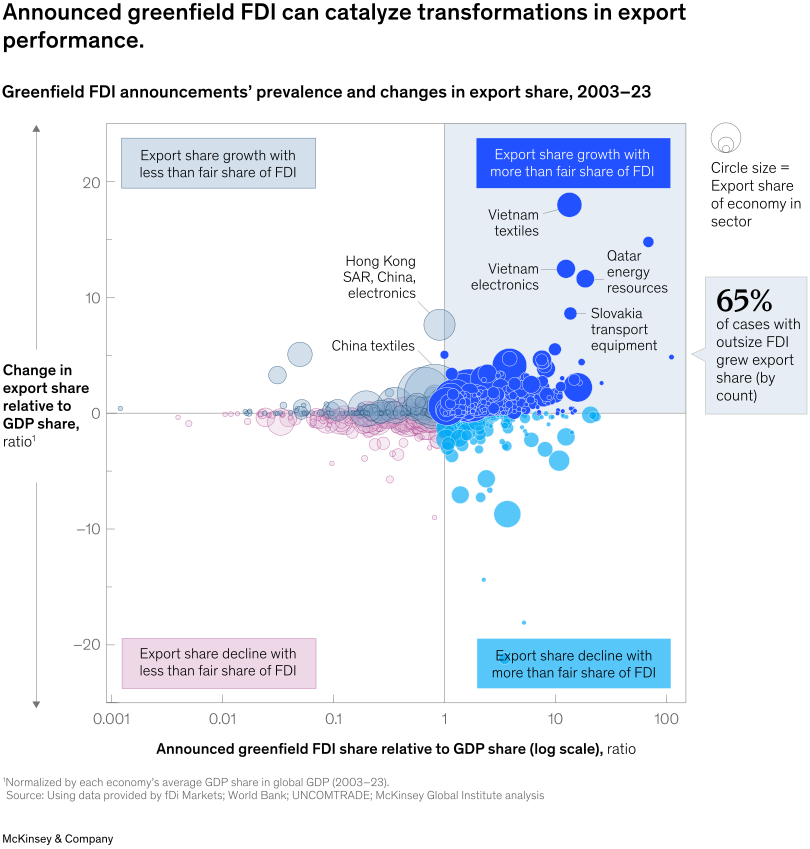
The strategic implication of this data is unambiguous. The analysis shows that 65% of sectors attracting a disproportionate share of FDI experienced significant growth in their global export share. This is not a coincidence; it is a predictable pattern of cause and effect that has boardroom-ready applications. Where capital flows, infrastructure develops, talent congregates, and market power accumulates. This is the new reality of global competition.
Consider Vietnam's electronics sector, a case study in how targeted FDI can re-architect an entire industry. Years of strategic investment have transformed it into a global manufacturing powerhouse, altering supply chains and creating intense pricing pressure for established players worldwide. This is not an isolated event but a repeatable model. The crucial question for any CEO is this: Is your strategy agile enough to capitalize on these emerging hubs? Or will you be blindsided by a new, highly-capitalized competitor that FDI helped create? Inaction is a strategic choice, and in this environment, it carries a significant EBIT impact.
The CEO's Playbook: Three Actions to Capitalize on Global Capital Flows
To navigate this landscape, leaders must move beyond internal metrics and adopt an external, forward-looking view. This requires a clear action plan to rewire the finance function and its inputs into corporate strategy.
- Mandate an External View: Task your CFO to integrate macro-investment trends into financial reporting and forecasting. The health of your company depends not just on its own balance sheet, but on the shifting economic landscape around it. This workflow redesign transforms the finance function from a historical scorekeeper into a source of measurable value creation.
- Stress-Test Your Value Chain: Use FDI data as a predictive map. It can identify promising new supplier markets to enhance operational resilience and reveal regions where competitors are gaining a state-sponsored or heavily-invested advantage. This proactive analysis provides the compliance guardrails and market intelligence needed to de-risk your supply chain.
- Leverage AI for Predictive Insight: Manually tracking global capital flows is an exercise in futility. Modern AI platforms, however, can monitor these trends in real-time, translating abstract economic data into concrete strategic alerts. This empowers leadership by turning the finance function from a historian into a prophet, providing the foresight needed to act decisively.


