Geopolitical FDI Shifts: A CEO's Strategic Playbook for Global Growth and Market Resilience

In today's volatile market, are you making strategic bets with yesterday's map? While your teams analyze market size and logistics, a powerful new undercurrent is deciding the next decade's winners and losers: geopolitical alignment. For a CEO, navigating this is no longer optional—it's the key to resilient growth and a critical strategic inflection point for global operations.
The End of 'Business as Usual': Why Geopolitics Now Dictates Global Capital Flow
For decades, foreign direct investment (FDI) decisions were guided by a reliable set of economic principles. Leaders assessed market size, labor costs, infrastructure, and regulatory environments. That model is now dangerously incomplete. The global landscape has bifurcated into distinct economic and political blocs, largely influenced by the United States and China. This shift introduces a new layer of complexity where capital has become inherently 'political'.
Investment decisions are now scrutinized for their geopolitical implications, impacting everything from supply chain stability to long-term market access. Relying on traditional economic analysis alone is no longer just insufficient; it's a direct threat to scalable growth. The new reality is that a country's diplomatic alignment can be a more potent indicator of risk and opportunity than its GDP growth rate.
Visualizing the New Global Chessboard: Where Does Your Business Fit?
To effectively navigate this complexity, leaders require a clear framework for understanding geopolitical alignment. The abstract nature of this risk can be made tangible by measuring quantifiable actions, such as UN General Assembly voting patterns over an extended period. This data-driven approach reveals which nations are moving closer to specific spheres of influence and, crucially, which are maintaining a neutral stance.
This insight provides a boardroom-ready map for de-risking future investments and partnerships. The following exhibit visualizes this new global chessboard, mapping countries based on their alignment and trade volumes.
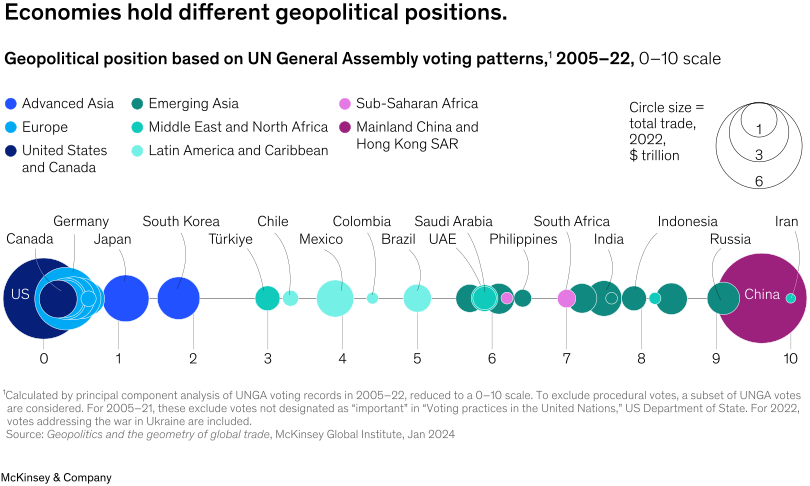
The implications are immediate and stark. The chart illustrates a clear clustering of trade and investment around two gravitational centers. For a CEO, this isn't an academic exercise; it's a visual representation of emerging operational risks and market opportunities. It reveals potential chokepoints in a supply chain, highlights the stability of key growth markets, and provides a foundational dataset for a more resilient global strategy.
The CEO's Playbook: Turning Geopolitical Insight into Competitive Advantage
Understanding the landscape is the first step. The next is to implement a clear action plan. Here are three strategic plays to turn geopolitical insight into a distinct competitive advantage.
- Play 1: De-Risk and Diversify Your Supply Chain. The map reveals how dependencies on geopolitically distant nations can create significant operational bottlenecks. The mandate is to evolve from a purely cost-centric supply chain model to a resilience-focused one. The action plan involves a deliberate workflow redesign to diversify suppliers into geopolitically aligned or neutral territories, creating a robust framework for risk mitigation.
- Play 2: Target 'Friend-Shoring' Growth Markets. Proactively use this alignment data to identify and prioritize expansion markets. The most promising opportunities are in nations that are not only economically attractive but also geopolitically stable and aligned with your core business ecosystem. This ensures that market access is less likely to be disrupted by sudden policy shifts, securing a reliable path to long-term growth.
- Play 3: Empower Finance with Predictive Intelligence. Transform the finance function from a historical scorekeeper into a strategic foresight engine. Traditional forecasting models rarely account for geopolitical volatility. By using AI-powered tools, CFOs can model how these shifts impact cash flow, profitability, and burn rate. This provides the compliance guardrails and predictive insight needed to make confident, forward-looking decisions about capital allocation and global investment.
Beyond Resilience: Building an Antifragile Global Strategy
The ultimate goal extends beyond mere resilience. The objective is to build an antifragile strategy—one that doesn't just withstand geopolitical shocks but actually gains from the resulting volatility. By integrating geopolitical data into the core of your financial and operational planning, your organization can move from a reactive posture to a predictive one.
This is how measurable value creation is achieved in the new global economy: by anticipating market movements, securing your international position, and turning uncertainty into a strategic asset for scalable growth.


