Global Investment Shifts: How CFOs Can Leverage AI to Capitalize on Future-Shaping Industries

Introduction: Beyond Rear-View Reporting
The C-suite no longer looks to the CFO for a history lesson; they need a weather forecast. In today's volatile market, there is mounting pressure from boards for finance leaders to transition from scorekeepers to forward-looking strategic partners. This strategic inflection point demands a new class of inputs for financial modeling. While many focus on internal metrics, a critical and often overlooked data source for predictive strategy lies in tracking macro shifts in Foreign Direct Investment (FDI).
The Global Capital Landscape Is Tilting
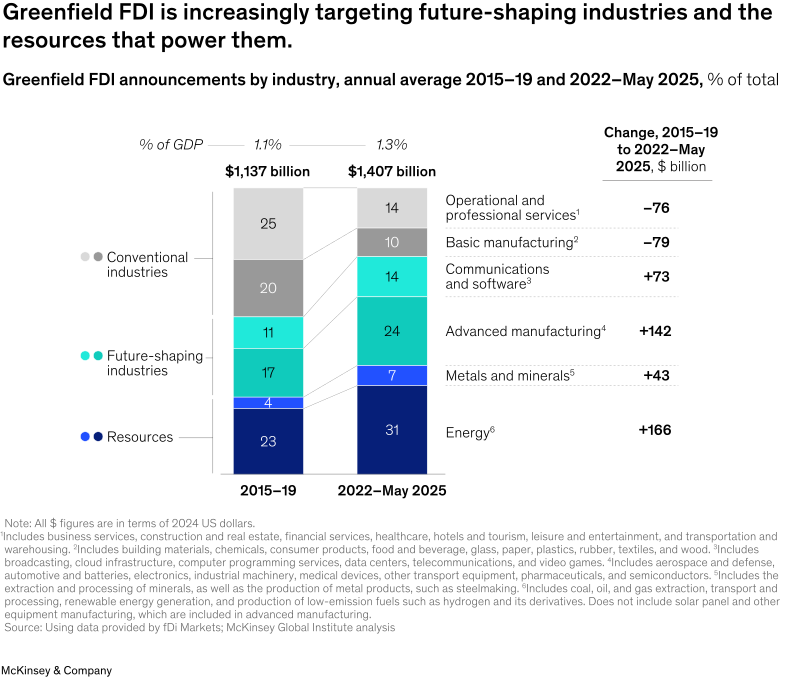
Greenfield FDI—investment in new facilities and operations in foreign countries—serves as a powerful leading indicator of long-term industrial and economic trends. It reveals where sophisticated global capital is being allocated, signaling which sectors are poised for substantial growth and which may face headwinds. Recent analysis of these flows indicates a dramatic and accelerating reallocation of capital, pivoting away from conventional sectors and toward a concentrated set of "future-shaping" industries.
What This $1.4 Trillion Shift Means for the Strategic CFO
The data presents an unambiguous signal: the ground is shifting beneath foundational economic assumptions. For the strategic CFO, this $1.4 trillion capital migration has profound implications. If your company operates within or supplies the "conventional industries" category—which has seen its share of FDI almost halve from 45% to 24%—your existing growth assumptions may be fundamentally flawed. Relying on historical data in this environment is not just conservative; it's a significant risk to future performance.
Conversely, this shift highlights a clear opportunity. The massive influx of capital into energy, advanced manufacturing, and software demands a new level of strategic financial analysis. How can your organization pivot its own capital allocation, M&A strategy, or market entry plans to capitalize on this trend? Answering these questions is now a boardroom imperative, as proactive competitors are already using this intelligence to gain a first-mover advantage.
Bridging the Gap: From Historical Data to Predictive Strategy with AI
Translating macro-level FDI data into company-specific, actionable strategy is a challenge that traditional FP&A processes are ill-equipped to handle. This is where AI becomes an essential tool for the modern finance function. AI-powered platforms provide the capability to model the second- and third-order effects of these investment shifts on your unique business.
Instead of manual analysis, AI agents can continuously monitor these trends and model their potential EBIT impact. They can simulate how shifts in global manufacturing capacity could affect your supply chain, identify nascent market opportunities in high-growth corridors, and automate the generation of forward-looking, boardroom-ready reports. This workflow redesign frees the CFO and their team from data consolidation to focus on high-level strategy and measurable value creation.
An Action Plan for the AI-Powered CFO
Moving from reactive reporting to predictive strategy requires a deliberate framework. For finance leaders ready to build a more resilient and opportunity-focused function, the path forward involves three pragmatic steps:
- Audit Your Forecasting Inputs: Assess your current models. Are they dynamic enough to incorporate external, unstructured data sources like FDI trends, or are they overly reliant on lagging internal indicators? The goal is to identify the agility gap in your current process.
- Identify a Pilot Project: Select a specific business unit or product line and deploy an AI-driven scenario planning tool. Use it to model the impact of these FDI shifts on revenue forecasts or supply chain costs. This creates a contained, low-risk environment to prove the concept.
- Build the Business Case: Frame the investment in AI not as a technology cost, but as a strategic imperative. Focus the business case on two core pillars: enhanced risk mitigation through more accurate forecasting and the tangible ROI of capitalizing on new growth opportunities identified through predictive analysis.
By taking these steps, CFOs can transform the finance function from a cost center into a strategic engine, providing the foresight required to navigate the changing global landscape with confidence.


