Economic Headwinds: A CFO's Strategic Guide to the 2025 Financial Outlook

The 2025 economic landscape is fraught with complexity. For Strategic CFOs, the pressure has never been greater to move beyond historical reporting and provide the forward-looking insights that guide confident decision-making. This playbook outlines how to navigate uncertainty and transform the finance function into a true strategic partner.
Reading the Signals: Key Macroeconomic Indicators for 2025
To navigate the path forward, a CFO must first interpret the external environment with precision. The following indicators represent the most significant strategic inflection points for financial planning in the coming year.
- Persistent Inflation and Interest Rate Volatility: Fluctuating capital costs are no longer a distant variable; they are a direct threat to budget integrity and investment returns. A volatile interest rate environment necessitates a more dynamic approach to forecasting, stress-testing the assumptions that underpin the entire financial plan and directly influencing EBIT projections.
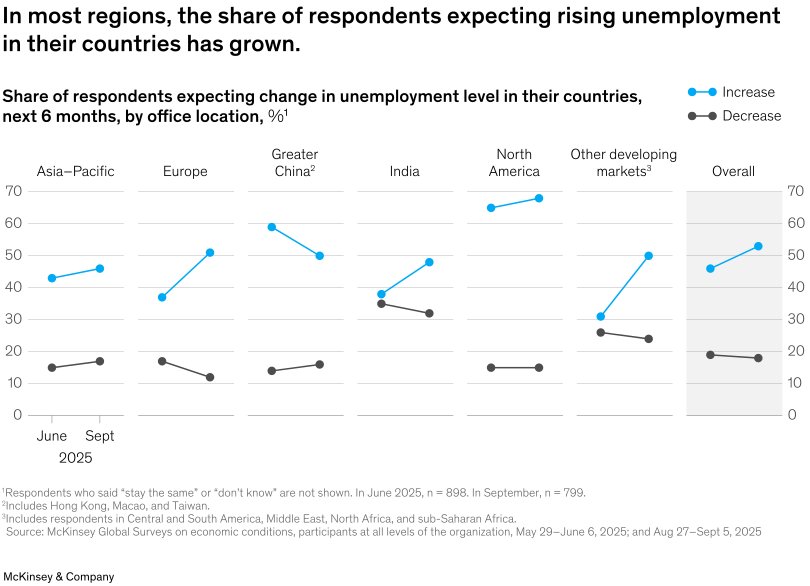
- Shifting Labor Market Dynamics: The global outlook on employment is a critical leading indicator of economic health, affecting everything from consumer demand to talent acquisition costs. As sentiment shifts, CFOs must prepare for potential impacts on growth projections and operational overhead.
- This data confirms a cooling global sentiment. For the CFO, this is not an abstract economic trend but a direct signal to reassess revenue forecasts, model the impact of softening consumer demand, and scrutinize SG&A expenses tied to a competitive labor market.
- Regulatory Scrutiny and Compliance Risks: In an environment of economic stress, regulatory bodies intensify their scrutiny. For businesses in Singapore, the increasing demands of compliance frameworks like IRAS and InvoiceNow represent a significant operational challenge. Without robust systems, the risk of costly errors and compliance breaches escalates, making integrated compliance guardrails a necessity, not a luxury.
The CFO's Mandate: From Financial Reporting to Strategic Foresight
Understanding the external landscape is only the first step. The true mandate for the modern CFO is to translate these macroeconomic signals into a clear, actionable corporate strategy, a task for which traditional methods are increasingly inadequate.
- The Limitations of Historical Data: Relying on historical performance to predict future outcomes in an unstable environment is like navigating a storm with only a rearview mirror. Past results offer little insight into the impact of unprecedented volatility, creating a compelling business case for a more forward-looking operational model.
- Embracing a Proactive Stance: The CFO must evolve from a financial steward to the organization's economic interpreter. This requires a workflow redesign that moves the finance function away from reactive reporting and toward proactive analysis, translating high-level economic data into specific, departmental action plans.
- The Business Case for Real-Time Insights: A multi-week closing process delivers a snapshot of the past, not a dashboard for the future. This strategic drag—the delay between event and insight—directly inhibits agile planning and cedes competitive advantage. The ability to access and analyze real-time data is fundamental to navigating uncertainty effectively.
Building Financial Resilience: A Three-Pronged Strategic Playbook
An effective response to uncertainty requires a structured framework. This three-pillar approach provides a clear action plan for building a resilient and agile finance function.
- Pillar 1: Fortify the Core with Intelligent Automation: Manual, repetitive processes are a bottleneck to scale and a source of unnecessary risk. Implementing AI-driven platforms automates reporting and embeds compliance guardrails directly into the workflow. This crucial first step reduces overhead and, more importantly, frees the finance team to focus on high-value strategic analysis rather than data reconciliation.
- Pillar 2: Master Dynamic Scenario Planning: A single, static budget is no longer defensible. The modern finance function must model multiple economic futures—recession, stagflation, or a soft landing. AI-powered tools enable CFOs to assess the potential impact of various scenarios on cash flow, debt covenants, and strategic investments, creating a boardroom-ready plan that is resilient by design.
- Pillar 3: Drive Board-Level Confidence: The ultimate role of the CFO is to guide executive decision-making. This requires transforming financial reports from static documents into compelling, data-driven narratives. By clearly communicating risk, outlining opportunities, and presenting a well-modeled financial strategy, the CFO can build the board-level confidence required to act decisively.
The Strategic Imperative: Leading Through Uncertainty
The challenges of 2025 are significant, but they also present an opportunity for strategic finance leaders to redefine their role and deliver measurable value creation.
- Summary of Key Actions: The path forward is clear. First, fortify your financial operations by automating core processes. Second, master dynamic scenario modeling to anticipate and prepare for multiple outcomes. Third, elevate your communication to drive board-level confidence with clear, data-driven narratives.
- Call to Action: The CFOs who thrive in the coming year will be those who leverage technology to transform their function from a cost center into the strategic engine of the enterprise. The risk of inaction is no longer theoretical; it is a direct threat to growth and stability. The time for a strategic workflow redesign is now.


