The CFO's GenAI Blueprint: Where to Invest for a 75% Productivity Gain

Introduction: From Cost Center to Value Architect: The CFO's Role in the GenAI Revolution
The board is no longer asking the CFO 'What happened?'; they're asking 'What's next?'. In this strategic inflection point for global business, the modern CFO must evolve from a historical record-keeper to a forward-looking value architect. Generative AI represents the single most significant opportunity to accelerate this transition, but only when viewed through the lens of strategic capital allocation. Championing technological adoption is no longer a discretionary IT expense; it is a primary driver of enterprise value. Successfully deploying GenAI is not a technical challenge—it's a financial one, requiring a CFO-led approach to identify high-ROI initiatives and construct a compelling, boardroom-ready business case.
Mapping the Opportunity: Where to Focus Your GenAI Investment for Maximum Impact
With finite capital and immense pressure to perform, the central question for every finance leader is one of allocation. Spreading GenAI investments thinly across the organization in a series of uncoordinated experiments is a recipe for budget overruns and anemic returns. A targeted approach, guided by rigorous data, is essential for measurable value creation. New analysis pinpoints precisely where GenAI can unlock its greatest potential, providing a clear roadmap for investment. The data reveals that nearly 75% of the total potential economic value from this technology is concentrated in just four critical business functions, offering a clear directive for CFOs aiming to maximize EBIT impact.
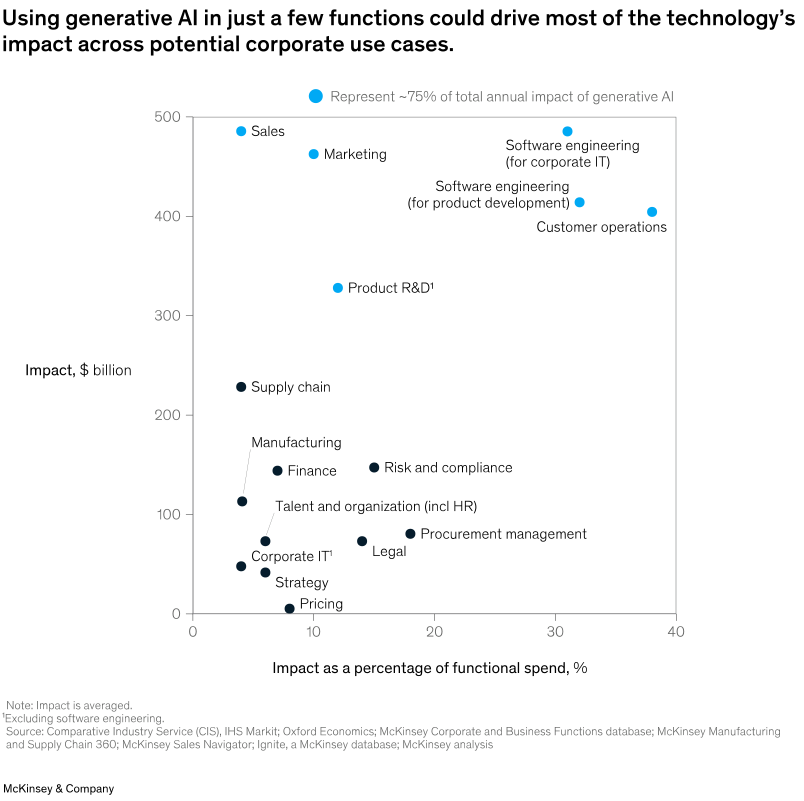
This exhibit provides an unambiguous answer to the allocation question. The findings from McKinsey are not merely academic; they are a strategic blueprint for capital deployment. For the CFO, this data transforms the conversation from speculative interest in AI to a focused investment strategy. The directive is clear: prioritize initiatives within customer operations, marketing and sales, software engineering, and R&D. Any proposed GenAI investment outside these domains requires a significantly higher burden of proof to justify its claim on the balance sheet. This data-driven framework allows the CFO to guide the organization toward projects with the highest probability of delivering substantial, near-term ROI.
The Strategic CFO's Playbook: Translating Insights into ROI
Knowing where to invest is the first step. The second, more critical step is building the financial framework to evaluate, approve, and measure these initiatives. This requires a disciplined, proactive approach to financial modeling and performance management.
- Build Cross-Functional Business Cases: The CFO must partner with functional leaders in the four key areas to architect ROI models that extend beyond simple cost savings. These models must forecast tangible impacts on revenue growth, market share capture, and customer lifetime value. This moves the justification from a cost-center efficiency play to a strategic growth initiative.
- Prioritize with a Portfolio Approach: A sophisticated CFO manages technology investments like a venture capitalist manages a portfolio. Balance high-certainty, high-efficiency plays (such as automating workflows in customer operations) with higher-variability growth bets (like accelerating new product development in R&D). This approach provides a clear framework for risk mitigation while pursuing transformative gains.
- Demand Forward-Looking Metrics: To truly shift the finance function from reactive to proactive, you must instrument your investments with forward-looking KPIs. Move beyond historical P&L analysis to measure GenAI's impact on developer productivity, sales cycle velocity, and marketing-qualified lead conversion rates. This reframes the entire conversation around growth and competitive advantage.
Mitigating Risk: Governance and Compliance in the Age of AI
While the potential for value creation is immense, the CFO must also serve as the primary steward of risk. Adopting GenAI without robust governance and compliance guardrails can introduce significant financial and regulatory vulnerabilities. A pragmatic workflow redesign ensures that AI adoption enhances, rather than compromises, financial integrity. This means developing clear protocols to ensure AI-driven processes are fully compliant with regulations like IRAS and national e-invoicing standards such as InvoiceNow, preventing costly penalties. Furthermore, implementing robust financial controls is non-negotiable. Establish clear tracking for AI-related operational expenses, such as model training and API calls, to prevent uncontrolled spending and ensure efficiency remains scalable.
Conclusion: Your First 90 Days as a GenAI-Powered Finance Leader
The journey from insight to impact requires a concrete action plan. To transform this strategic framework into tangible results and build momentum with the board, a disciplined 90-day approach is essential. This is how you move from theory to execution.
- Day 1-30: Align & Educate: Convene the leaders of customer operations, marketing and sales, software engineering, and R&D. Present the data and co-develop a short list of pilot proposals grounded in clear business outcomes.
- Day 31-60: Launch a High-Impact Pilot: Select one initiative with a clear, measurable, and achievable outcome within a 30-day window. The goal is to prove value, de-risk the technology, and build essential internal expertise.
- Day 61-90: Build the Strategic Roadmap: Leverage the results and learnings from the pilot to construct a multi-year investment plan. This boardroom-ready document will serve as the financial and operational blueprint for scaling GenAI and securing a sustained competitive advantage.


