Beyond Pilots: How CEOs Scale Agentic AI for Profitable Growth

Your company is investing in artificial intelligence, running pilots, and demonstrating potential. But is that potential translating into profitable growth? For the vast majority of organizations, the answer is a strategic liability. Their AI initiatives are becoming expensive science projects, not the decisive business drivers required to navigate market volatility. This is the AI pilot trap: a cycle of experimentation without meaningful, scaled execution.
The Stalled AI Revolution: Why Most Companies Are Stuck in the Pilot Phase
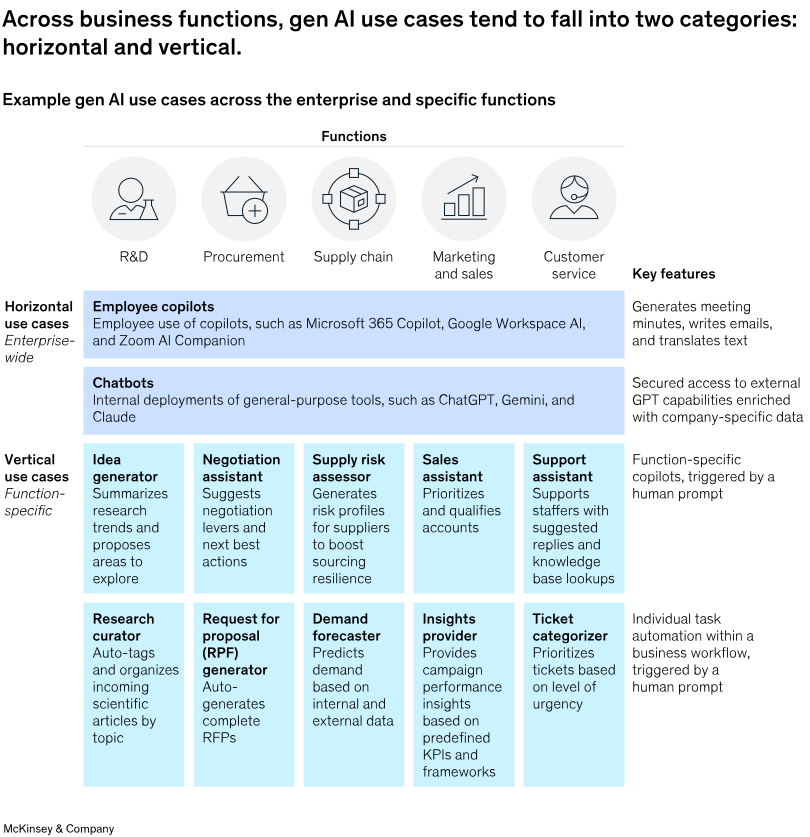
The core of the issue lies in a disconnect between technical possibility and strategic implementation. While horizontal AI applications have seen broad adoption, the high-value, function-specific vertical AI use cases are failing to launch. The data exposes a critical operational gap. According to recent McKinsey research, fewer than 10% of these high-potential AI projects ever move beyond the pilot phase. This failure to scale prevents them from delivering the reliable data and workflow redesign needed for leaders to make confident, forward-looking decisions.
The CEO’s Mandate: Shifting from Isolated Experiments to Strategic Scaling
The data above is not a technology problem; it is a leadership challenge that requires a direct CEO-level mandate. Breaking out of the pilot trap demands a strategic inflection point—a shift in focus from automating isolated tasks to fundamentally transforming core business functions. The mandate is to move AI from the IT budget line to the core of the company’s operating model.
The objective isn't merely to deploy technology. It is to build a more resilient, efficient organization where growth does not trigger a proportional increase in back-office overhead. For a CEO, this is about managing SG&A costs and ensuring that operational drag does not limit the company's momentum. Scaled AI is the mechanism to achieve this, but only if it’s approached as a strategic imperative, not a series of disconnected experiments.
A Blueprint for Scaling Agentic AI in Your Finance Function
For most CEOs, the most logical and impactful place to begin this transformation is the financial core of the business. The finance function is the source of the data that drives every major decision. An effective action plan for the CEO to champion this change involves three focused steps:
- Target the Bottleneck, Not Just the Task. The most common mistake is automating a single, discrete task within a broken workflow. The correct approach is to identify the most significant strategic bottleneck—such as the time required to close the books, the accuracy of financial forecasting, or the visibility into cash flow—that directly hinders confident decision-making. This is the starting point for a meaningful workflow redesign.
- Define Success Metrics for Growth, Not Just Savings. The ROI timeline for scaled AI should be measured in more than just cost reduction. The true, boardroom-ready metrics of success are the velocity of strategic decisions, the clarity and reliability of financial data, and the company's ability to scale revenue without breaking its operational model. This is how you measure the EBIT impact of decisiveness.
- Implement with Compliance Guardrails. Scaling is impossible without trust. For the finance function, trust is built on a foundation of control and compliance. Any AI initiative must be implemented with robust compliance guardrails from day one. This ensures data integrity, mitigates risk, and provides the governance structure necessary to move from a pilot to a core business system.
Beyond Automation: Building a Proactive, Growth-Oriented Business
Ultimately, scaling Agentic AI is about transforming the nature of the finance function itself—from a reactive reporting center to a proactive, strategic partner in value creation. It’s about creating an environment where the leadership team has on-demand, reliable data to act on opportunities and mitigate risks with precision.
The cost of inaction is no longer theoretical; it’s a measurable drag on performance. For the CEO, the directive is clear: lead the shift from isolated experiments to a fully integrated, scaled AI strategy. This is how you protect your company's momentum and turn guesswork into a durable strategic advantage.


