CEO's Guide to Agentic AI: Goals, Decisions, and Strategic Implications for Growth

As a CEO, you are consistently forced to make critical growth decisions using a rear-view mirror: last month’s financial reports. This operational model forces guesswork where you need certainty, creating a strategic drag on the entire enterprise. What if your financial operations could move at the speed of your ambition? Agentic AI isn't just another automation tool; it's a new class of system designed to execute on strategic goals, turning your finance function from a cost center into a real-time engine for growth.
The Bottleneck to Growth Isn't Your Team, It's Your Data's Speed
The core challenge for any scaling enterprise is not a lack of vision, but a lack of visibility. Strategic decisions around market entry, capital allocation, and product investment demand real-time data. Yet, the output of most finance departments is, by its nature, historical. This data lag creates a dangerous gap between ambition and execution, forcing leadership to rely on instinct rather than verifiable insight for mission-critical choices.
This operational friction has a direct EBIT impact, manifesting in delayed opportunities and misallocated resources. The true bottleneck to scaling isn’t your operational capacity or the talent of your team; it's the speed at which you can trust and act on your own financial intelligence. To break through this growth ceiling, leaders must fundamentally redesign the workflows that produce that intelligence.
Introducing Agentic AI: Your New Partner in Strategic Finance
For the boardroom, Agentic AI can be understood as a goal-oriented system capable of reasoning, planning, and executing complex tasks to achieve a desired business outcome. This represents a strategic inflection point in how we approach financial operations. Traditional automation is task-oriented—it executes a predefined, repetitive process like paying an invoice. An AI agent is goal-oriented—it can be tasked with a strategic objective, such as "optimize cash flow across all subsidiaries" or "ensure 100% regulatory compliance for all cross-border transactions."
This distinction is critical. While automation improves the efficiency of an existing process, an agent can manage the entire process itself, adapting to new information and making decisions to stay aligned with its primary goal. This capability moves AI from the back office into a strategic partnership role.
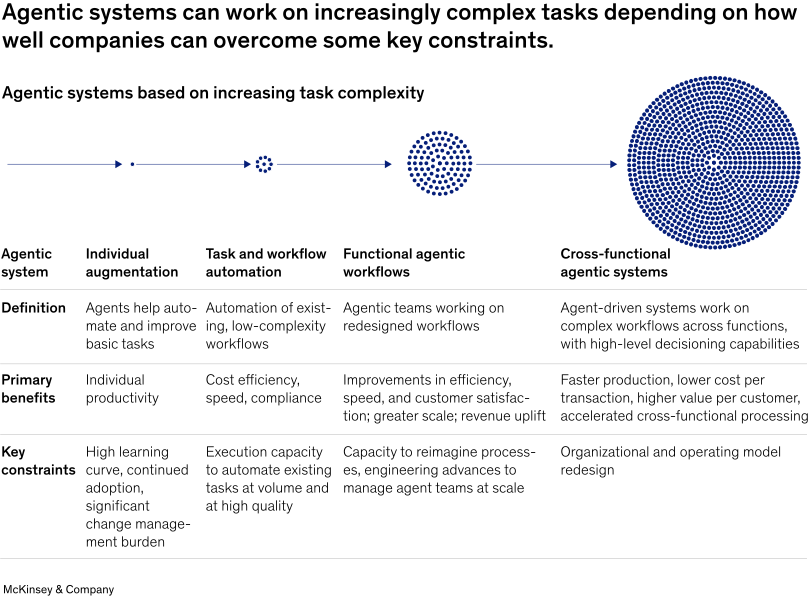
As the exhibit from McKinsey illustrates, agentic systems operate on a spectrum of complexity. The true strategic advantage is unlocked by moving beyond simple task execution to sophisticated, goal-directed actions. This evolution is the key to transforming the finance function from a reactive reporting body into a proactive engine for measurable value creation. It allows the CEO and CFO to architect and orchestrate financial operations, rather than simply manage them.
From Guesswork to Growth: Three CEO-Level Decisions Powered by Agentic AI
Achieve Scalable Growth Without Bloat: Aggressive growth often leads to a proportional increase in administrative overhead, inflating SG&A costs. AI agents can manage entire back-office functions like accounts payable, reconciliation, and compliance reporting autonomously. This allows you to decouple headcount from revenue growth, enabling you to invest capital in strategic initiatives, not administrative headcount.
Gain Real-Time Financial Command: Board-level surprises are liabilities. Agentic AI provides an on-demand, trusted view of cash flow, profitability, and burn rate. By processing and verifying financial data in real time, agents eliminate the blind spots between reporting cycles, enabling confident, proactive decisions before risks escalate into crises.
Proactively Protect Your Reputation: In an increasingly complex regulatory environment, human error is an existential risk. You can deploy agents as tireless auditors, enforcing compliance guardrails and detecting financial anomalies in real time. This workflow redesign safeguards the business against fraud and error, providing a new layer of risk mitigation that protects shareholder value and brand reputation.
Your First 100 Days: A CEO's Blueprint for Implementation
Adopting Agentic AI is not an IT project; it is a strategic business initiative. This framework provides a clear action plan for the first 100 days.
- Step 1: Identify the Highest-Value Bottleneck. Begin with a single, high-impact process where delays directly impede strategic visibility. Month-end closing, invoice processing, and cash flow reconciliation are prime candidates. The goal is a quick, measurable win that demonstrates the business case.
- Step 2: Empower Your Finance Leader. This initiative must be led by your finance team. Frame the objective as a strategic transformation of their function—from a historical cost center to a forward-looking growth partner. Provide them with the executive support to lead this workflow redesign.
- Step 3: Demand a Clear Business Case. The objective is not technology for its own sake. The success of the initial deployment must be tied to a measurable impact on scalability, decision speed, or risk reduction. Insist on a clear ROI timeline and performance benchmarks before scaling further.
By focusing on strategic outcomes over technical features, CEOs can effectively lead their organizations to the next stage of autonomous, scalable growth.


