Strategic Advantage Through Top-Team Performance: A CEO's Blueprint for Growth

Your financial reports tell a story, but what about the story they don't tell? The one about the hidden friction within your leadership team that's secretly throttling your company's growth potential. While you're focused on burn rate and profitability, the real bottleneck might be the very operating system of your executive team.
The Real Bottleneck to Scalable Growth Isn't in Your P&L
Many CEOs correctly identify inefficient back-office processes and slow reporting as primary obstacles to scale. However, these are often symptoms of a deeper issue: a lack of strategic alignment and role clarity at the executive level. The true strategic inflection point lies not in optimizing a single workflow, but in redesigning the decision-making framework at the top.
- When executive roles and responsibilities are ambiguous, decisions lag, resources are misallocated, and conflicting departmental priorities create friction. This reverberates through the entire organization, materializing as the operational drag and delayed reports that make strategic decisions feel like guesswork.
- The inefficiency isn't a problem of process; it's a problem of design. Without a clear mandate from a unified leadership team, functions like finance are forced into a reactive, historical reporting role instead of becoming proactive partners in creating measurable value.
The Data-Driven Framework for a High-Performance Executive Team
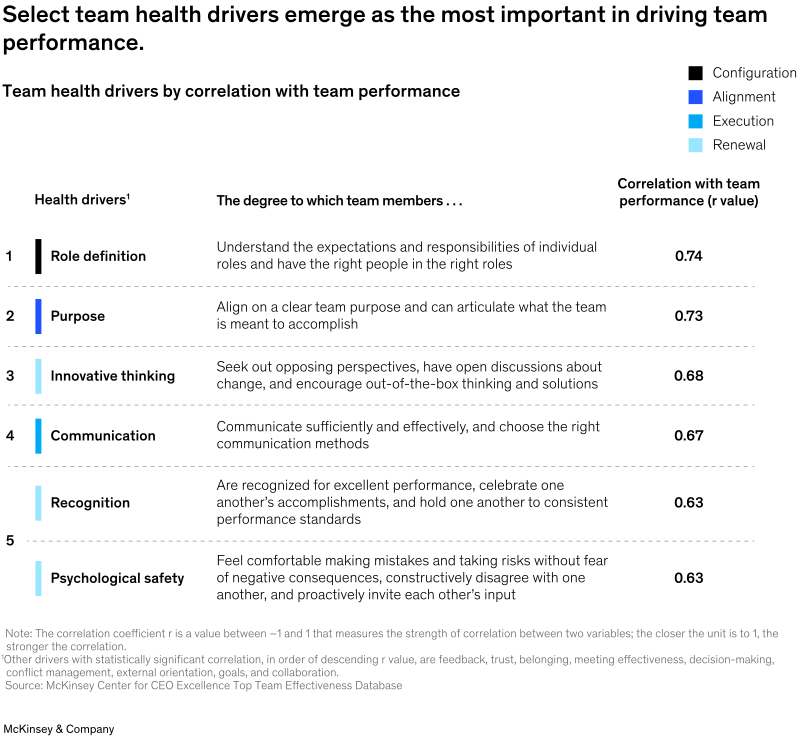
To move beyond guesswork and architect a leadership team capable of driving scalable growth, a data-driven framework is required. A comprehensive analysis of top-team effectiveness reveals the precise behaviors and conditions that have the highest statistical correlation with overall performance. This provides an objective action plan for targeted improvement, moving the conversation from opinion to evidence.
Blueprint for Action: Focusing on the Two Most Critical Drivers
The data provides a clear mandate for prioritization. While all six drivers are important, two stand out as the foundational elements for elite performance, offering the highest ROI for a CEO’s attention.
- Sharpen Role Definition: With a correlation coefficient of 0.74, role clarity is the single most important factor. This is a boardroom-ready directive that goes beyond titles on an org chart. It requires codifying ownership of specific KPIs, defining clear decision rights, and mapping accountability for cross-functional outcomes. The objective is to eliminate ambiguity entirely, creating the conditions to accelerate execution and mitigate the risk of critical initiatives stalling between silos.
- Codify Your Purpose: A shared purpose, with a correlation of 0.73, is the strategic glue that binds an executive team. When every leader understands and can articulate the company's core mission and its translation into market strategy, their teams and budgets naturally align. This alignment empowers functions like finance to move beyond historical accounting and provide forward-looking insights, becoming true strategic partners in the growth agenda.
Mitigating Hidden Risks: Why Psychological Safety and Innovation Matter
The analysis also reveals a critical vulnerability: the two drivers that are often most underdeveloped in executive teams are innovative thinking and psychological safety. Ignoring these doesn't just cap potential; it introduces significant, unmeasured risk.
- A lack of psychological safety creates an environment where bad news is buried and divergent opinions are suppressed. This directly elevates the risk of compliance failures, fraud, or major operational issues going undetected until they become catastrophic. It dismantles the very compliance guardrails a CEO needs to lead with confidence.
- Without a deliberate focus on fostering innovative thinking, the executive team defaults to linear solutions and incremental improvements. This conservative posture makes it impossible to design the novel operational models required for non-linear, scalable growth, effectively ceding ground to more agile competitors.
Conclusion: Your Leadership Team as a Growth Multiplier
The data is unequivocal: your leadership team's internal dynamics are a direct and powerful predictor of your company's performance. Optimizing for clarity, purpose, and safety is not a 'soft' initiative; it is the fundamental mechanism for building a scalable, resilient business with a durable competitive advantage.
By treating your top team's effectiveness as a key strategic priority—equal to any technology investment or market analysis—you create the alignment required to gain a clear, on-demand view of the business. This empowers every department to execute on a unified vision for growth, transforming your leadership team from a management function into your most potent growth multiplier.


