Strategic Blueprint: How CEOs Can Unlock Generative AI's Economic Potential for Growth

Your company's growth is being bottlenecked by decisions made looking in the rearview mirror. While your team compiles last quarter's data, your competitors are using generative AI to model next quarter's opportunities. The strategic inflection point for today’s CEO is not whether to adopt AI, but how to architect its rapid integration to create measurable economic value.
Why Your Current Growth Engine Is Sputtering
If your strategic decisions feel reactive or based on incomplete data, you're not facing a personnel issue; you're facing a systems issue. The conventional operating model for finance and strategy is reaching its ceiling, creating predictable drags on performance.
- The Lagging Indicator Trap: Traditional financial reporting delivers a historical snapshot, a detailed account of a past that is already gone. This makes proactive, forward-looking decisions nearly impossible. When strategy is based on last quarter's numbers, the business is perpetually one step behind market shifts, turning decisive action into educated guesswork.
- The Scaling Bottleneck: Inefficient back-office processes and fragmented data silos don't just inflate SG&A costs—they act as a direct brake on market expansion. Every new market or product line adds a disproportionate layer of complexity, limiting agility and creating an operational drag that prevents the business from achieving scalable, profitable growth.
- The Hidden Risk of Inaction: The true risk is not the cost of new technology, but the escalating cost of maintaining an outdated operational model. In a market where competitors are leveraging AI to accelerate their decision cycles and de-risk operations, standing still is a direct threat to market share and shareholder value.
Generative AI: The New Productivity Frontier for Leadership
Generative AI represents a fundamental shift in value creation. It's not about automating repetitive tasks anymore; it's about augmenting the high-stakes knowledge work that has traditionally been resistant to technological leverage.
- Beyond Automation: Augmenting Expertise: The real revolution of generative AI is its capacity to enhance the core activities that drive strategy: analysis, scenario modeling, and decision-making. It acts as a force multiplier for your most valuable talent, allowing them to focus on strategic interpretation rather than manual data reconciliation.
- Unlocking a New S-Curve for Growth: This shift is creating a new productivity frontier. Recent analysis from McKinsey & Company quantifies this leap, showing a dramatic increase in the potential to automate managerial and expertise-based tasks—the very engine of corporate strategy.
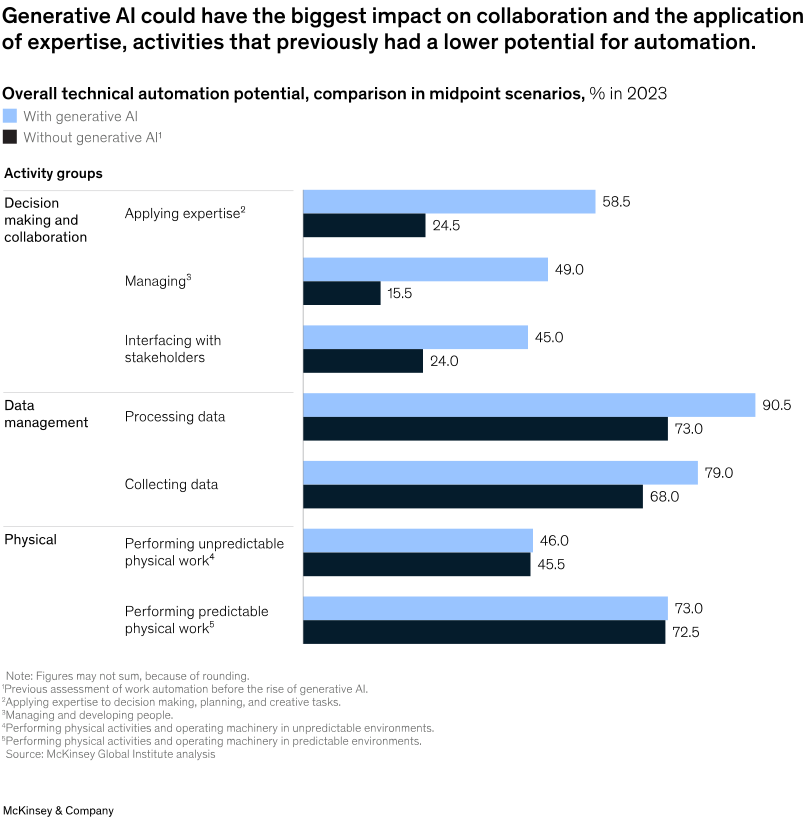
- What This Means for the C-Suite: The data is boardroom-ready and its implications are clear. The significant jump in automation potential for management and expertise empowers the entire leadership team to operate at a higher strategic plane. This is the catalyst that transforms functions like finance from historical cost centers into forward-looking growth partners, focused on modeling future EBIT impact rather than reporting on past performance.
A CEO's Blueprint for Capturing AI's Economic Value
Capturing this value requires a deliberate action plan, not a series of disconnected IT projects. This three-step framework provides a clear path to execution.
- Step 1: Mandate a Single Source of Truth: The prerequisite for intelligent automation is data integrity. The CEO must mandate the creation of a unified data environment for all financial and operational data. AI becomes the engine that synthesizes this data, providing the on-demand, trusted view of business health required for confident, high-velocity decisions.
- Step 2: Transform Your Finance Function into a Forward-Looking Partner: A workflow redesign, powered by AI, is necessary to shift the finance function from historical reporting to predictive advisory. The goal is to equip your CFO with the tools for sophisticated scenario modeling and financial forecasting, turning their team into a strategic asset that guides resource allocation and identifies opportunities for value creation.
- Step 3: Build a Scalable and Resilient Operating Model: True scale is achieved when growth in revenue is decoupled from growth in overhead. Implementing AI with embedded compliance guardrails de-risks the business and creates an efficient operational infrastructure. This allows for profitable expansion without the friction and ballooning costs of legacy systems.
Your Next Move: Leading the AI-Powered Enterprise
The transition to an AI-powered enterprise is a test of leadership. It is a strategic imperative that cannot be delegated.
- From Delegation to Declaration: AI adoption is a CEO-level mandate, not an IT initiative. The leader's role is to declare the strategic vision, articulate the expected business outcomes, and empower the organization to execute a fundamental workflow redesign.
- The Cost of Waiting Is Greater Than the Cost of Acting: In today's competitive landscape, the window for observation has closed. The risk of being outmaneuvered by more agile, data-driven competitors is now greater than the risk of implementation. The time for decisive leadership is now.


