Building a High-Performing Top Team: A CEO's Playbook for Scalable Growth

Are you making multi-million dollar decisions based on last month's numbers? For many growth-focused CEOs, this isn't just a frustration—it's a critical business risk. The lag between performance and reporting creates a dangerous blind spot, forcing strategic choices to be made with incomplete intelligence. The root cause, however, is rarely the accounting software. The true strategic inflection point lies with the leadership team responsible for producing and acting on those insights.
The Real Bottleneck to Scalable Growth Isn't Your Tech Stack—It's Your Top Team
When financial reports are slow, inconsistent, or lack strategic depth, the tendency is to scrutinize systems and processes. But the more fundamental issue is often human. An inefficient back-office is a symptom of a misaligned leadership team, which acts as a drag on growth and introduces unmanaged risk.
- Misalignment Creates Strategic Friction: When functional leaders operate with competing agendas or unclear mandates, the result is a set of conflicting, siloed financial reports. The CFO's office spends its time reconciling disparate data sets instead of analyzing forward-looking trends. This operational friction directly causes the guesswork and delays that CEOs must avoid to maintain a competitive edge. The direct EBIT impact is felt in stalled decisions and misallocated capital.
- A Lack of Psychological Safety Hides Risk: In a leadership environment where challenging the status quo is discouraged, critical financial realities remain unspoken. Team members may hesitate to flag budget overruns, optimistic sales forecasts, or potential compliance gaps. This absence of candid dialogue is not a culture problem; it is a significant business risk, creating the conditions for compliance failures, financial mismanagement, or even fraud.
A CEO's Playbook for Engineering a High-Performance Leadership Team
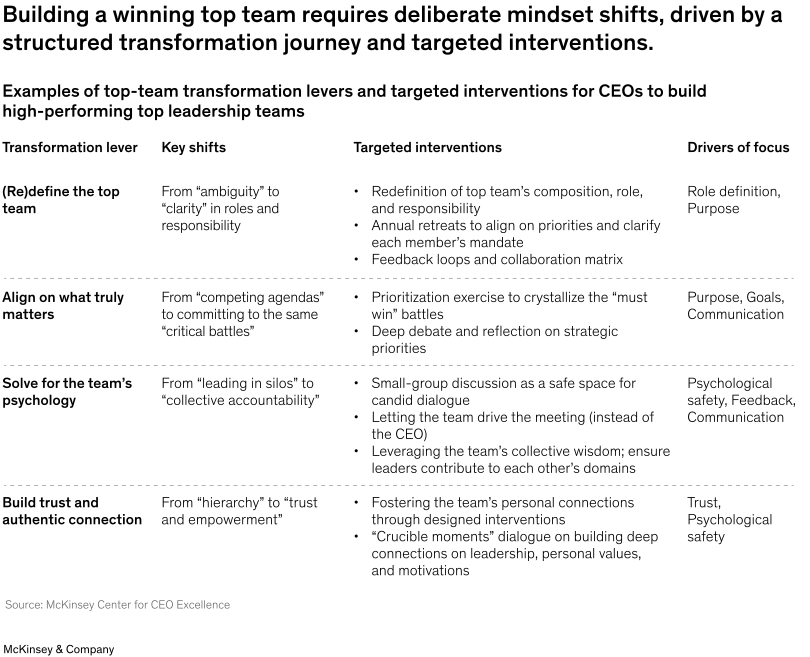
A high-performing top team is not built by accident. It is engineered through a series of deliberate, strategic interventions designed to create clarity, alignment, and trust. The goal is to transform the leadership team from a collection of functional heads into a cohesive unit focused on measurable value creation. Authoritative data provides a clear action plan for this transformation.
From Framework to Action: Four Levers to Drive Alignment and Accelerate Decisions
The framework presented above offers a clear roadmap. For CEOs, the task is to translate these concepts into a concrete workflow redesign for their leadership team. This requires focusing on four key levers that have a direct impact on financial and operational outcomes.
- Lever 1: Redefine Roles to Gain a Clear View of Profitability. Ambiguity is the enemy of accountability. When leadership roles and responsibilities are ill-defined, ownership of financial outcomes becomes diluted. By clearly mapping each leader’s responsibilities to specific P&L drivers, a CEO creates direct lines of accountability. This clarity is the foundation for a trusted, on-demand view of cash flow, profitability, and burn rate.
- Lever 2: Align on 'Must-Win Battles' to Focus Resources. A leadership team trying to do everything at once will achieve nothing of consequence. The fastest way to generate reliable data for confident decision-making is to force alignment on a small number of critical priorities. This disciplined focus ensures that analytical resources are directed at what truly matters, providing the boardroom-ready insights needed to make decisive capital allocation and strategy calls.
- Lever 3: Foster Psychological Safety to De-Risk the Business. Open dialogue and candid feedback are not soft skills; they are essential risk mitigation tools. By creating structured forums for debate, a CEO establishes the compliance guardrails necessary to surface and address problems before they escalate. This transforms the team's psychology from one of siloed self-preservation to one of collective accountability for the enterprise's financial health and integrity.
Your Leadership Team: The Engine of Scalable, Profitable Growth
Ultimately, a cohesive leadership team is the primary driver of the hard financial and operational outcomes a CEO is measured on. The quality of financial forecasting, the speed of strategic decisions, and the robustness of the company's risk framework are all direct outputs of top-team effectiveness.
Empowering your leadership team is not just good management; it is the most effective strategy for building a scalable, resilient, and profitable enterprise. The first step is to recognize that the bottleneck isn't in the system—it's in the room.


