Empowering the C-Suite: Aligning Top-Team Performance for Financial Strategic Advantage

Your C-Suite: Growth Accelerator or Financial Bottleneck?
The pace of your business is relentless, yet critical decisions feel sluggish, constrained by financial reports that only look backward. This friction between market speed and internal velocity is a common strategic inflection point for growth-stage companies. While the immediate symptom appears to be a data problem, the root cause is often more fundamental.
This isn't just a reporting issue; it's a leadership alignment problem. A disconnected C-suite—where roles are ambiguous, objectives diverge, and execution is fragmented—inadvertently turns strategic assets into operational bottlenecks. The result is a drag on performance that hinders the scalable, profitable growth you are targeting and undermines the very foundation of your financial strategy.
A Framework for High-Performance Executive Teams
To scale effectively, a CEO must architect the leadership team with the same analytical rigor applied to the business model. The transition from an intuitive, reactive leadership style to a deliberate, structured one is essential for sustainable growth. The key is to systematically evaluate and enhance your executive team's operational health.
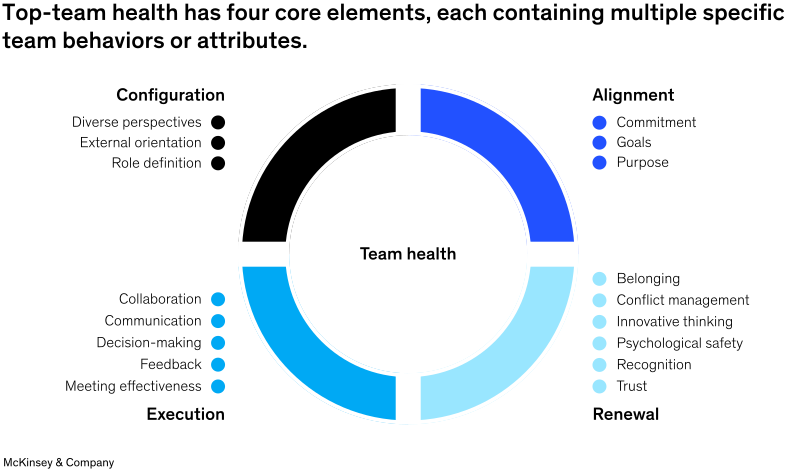
A comprehensive analysis by McKinsey provides an authoritative framework for this, revealing that top-performing teams consistently excel across four core dimensions. Understanding this model provides a clear, actionable blueprint for C-suite optimization and transforms team dynamics from an intangible concept into a measurable driver of financial performance.
Connecting Team Dynamics to Financial Outcomes
This framework is more than a theoretical model; it's a direct driver of financial performance. By dissecting the four dimensions, we can draw a clear line between team health and the boardroom-ready metrics that matter: profitability, cash flow, and risk mitigation.
- Configuration and Alignment: When executive roles are clearly defined (Configuration) and strategic goals are universally shared (Alignment), the organization eliminates the internal friction that delays critical decisions. This clarity translates to faster, more confident capital allocation and quicker strategic pivots in response to market shifts. The direct EBIT impact is realized through reduced operational drag and more agile resource deployment.
- Execution: Effective execution is where strategy becomes tangible. It encompasses clear communication, decisive meetings, and collaborative workflows that transform financial data from a historical record into a real-time strategic asset. This operational discipline provides the trusted, on-demand view of cash flow and burn rate required to lead with conviction, ensuring that decisions are based on current reality, not outdated reports.
- Renewal: The dimension of Renewal—a culture built on trust, psychological safety, and constructive conflict—is not a "soft" benefit. It is your primary defense against the compliance failures and internal fraud that can derail a growing company. A resilient team that can openly challenge assumptions and innovate without fear builds the institutional strength required to sustain momentum through market cycles, mitigating risk and fostering long-term value creation.
From Bottleneck to Boardroom Advantage
Stop treating C-suite performance as an intangible. Your executive team is the most critical piece of operational infrastructure you own. By systematically strengthening its configuration, alignment, execution, and renewal, you create the conditions for your finance function—and the entire business—to thrive.
The objective is a fundamental workflow redesign at the leadership level. The result is an organization that doesn't just grow, but scales profitably and sustainably. A high-performing, financially aligned C-suite is not merely a goal; it is your primary and most defensible competitive advantage in a volatile market.


