Navigating Trade Policy Shifts: An AI-Powered Financial Strategy for CFOs

The CFO's role has transitioned from archiving historical data to devising a strategic, forward-thinking plan that navigates through the unpredictable ripples of today's global economy. Traditional methods centered around static forecasts and lagging indicators struggle to provide an accurate response to the abrupt shifts in trade policy.
The New Economic Battlefield: Why Trade Policy is a CFO's Top Concern
Macroeconomic risks, particularly the fickle terrains of trade policy, have emerged as the primary threats to financial stability, leading to a significant reduction in forecasting certainty. Research reveals that trade policies are now synonymous with geopolitical instability as one of the highest tangible risks for executives.
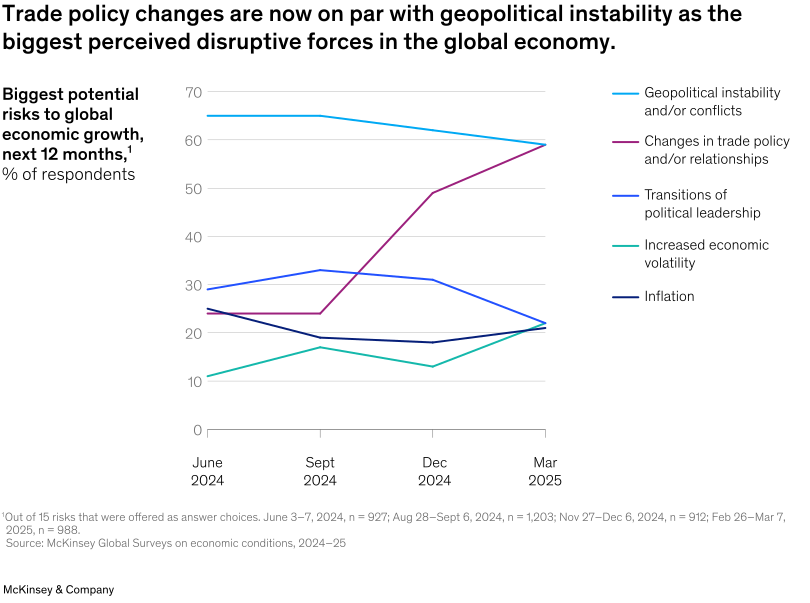
Impromptu tariffs create instability in COGS, supply chain disruptions influence cash flow fluctuations, and currency volatility complicates forecasts. In essence, inaccurate forecasting is a pain that CFO's often find challenging to mitigate.
From Reactive to Predictive: Building Financial Resilience with AI
Integrating AI into financial strategy does not merely accelerate technological advancements; it remodels the finance function from a reactive to a proactive, predictive game changer in the business arena. AI tools facilitate real-time scenario planning, enhance forecast accuracy, and ensure automated compliance monitoring. Implementing such strategies support the CFO's mission of mitigating risk while delivering faster, dynamic insights to the board.
An AI-Powered Playbook for Navigating Trade Volatility
Implementing a dynamic AI strategy involves three key steps: unifying data to provide an extensive, real-time scenario planning, employing predictive analytics to manage risks proactively, and automating compliance and strategic reporting. By automating the mundane tasks of manual reporting, finance teams can now focus on strategic analyses that provide high-value insights, decreasing the bottlenecking caused by archaic reporting methods.
Conclusion: The CFO as Strategic Futurist
In this era of constant economic flux, implementing AI is no longer a choice but a necessity for successful financial leadership. For a CFO, the opportunity lies in leveraging AI to secure their company's financial future and thus, evolve from a mere financial steward to a strategic leader.


