CEO's Compass: Why AI is the #1 Strategic Bet for Growth Leaders in 2025

In a landscape of persistent economic uncertainty, the most critical question for a CEO isn't "what's next?" but "where should we focus now?" While many leadership teams are distracted by shifting trade policies and supply chain disruptions, a new class of leaders is placing a single, decisive bet. New data reveals a strategic schism—and winning companies are choosing AI as their primary engine for growth.
The Widening Gap: Are You Placing the Right Strategic Bets?
The primary challenge for today's CEO isn't a lack of options, but a lack of clarity on which option will secure future growth. Every decision carries weight, and making a call based on rearview-mirror data or operational guesswork is a significant, unmeasured risk. A strategic inflection point has been reached, and peer priorities are diverging with profound implications for competitive advantage.
While some industries remain focused on traditional economic headwinds, forward-looking sectors like technology and financial services are pivoting decisively. They see a different, more powerful lever for creating measurable value—one that moves beyond reacting to market volatility and instead builds the internal capability for proactive, intelligent action.
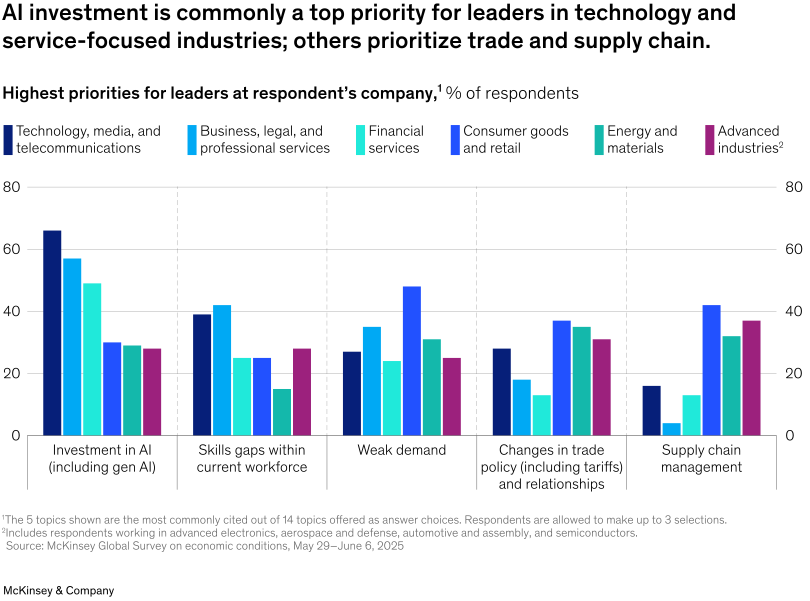
Decoding the Shift: Why AI is the New Engine for Scalable Growth
The data from McKinsey reveals a clear pattern: leaders who prioritize AI are no longer willing to accept the limitations of reactive, historical reporting. They are investing in systems that provide on-demand, forward-looking intelligence—the essential ingredient for confident, high-stakes decision-making. The frustration with slow, unreliable financial reports that hinder agility is now directly driving boardroom-level investment strategy.
This pivot recognizes that AI isn't just another line item; it is the core infrastructure for scalability. The manual, inefficient back-office processes that plague most organizations act as a bottleneck to growth, increasing overhead and dragging on EBIT. AI-driven workflow redesign automates these processes, allowing the business to expand without being weighed down by a proportional increase in operational cost.
For tech and finance leaders, this strategic priority serves a dual purpose. It not only delivers operational efficiency but also empowers their finance teams to transcend historical reporting. By providing them with the tools for real-time analysis and foresight, AI elevates the finance function from a cost center focused on spreadsheets into a proactive partner in strategic growth.
The CEO's Action Plan: Turning AI Insight into Competitive Advantage
Harnessing this opportunity requires a clear framework. For the CEO, the path forward is not a technical implementation but a strategic initiative.
1. Reframe the Conversation: The first step is to stop treating AI as an IT project and start treating it as a core business strategy. The discussion must be elevated to a boardroom level, centered on mitigating risk, creating a competitive advantage, and delivering a clear ROI timeline.
2. Empower Your CFO: Task your financial leader with championing an AI-driven finance transformation. Their mandate should be to identify and implement a solution that provides a single source of truth for the entire business, complete with the compliance guardrails necessary for sound governance.
3. Target the Bottleneck: The fastest path to ROI and strategic clarity is by automating the financial back office. This initial focus is what unlocks the real-time cash flow, profitability, and burn-rate data that high-growth companies need to navigate uncertainty and seize opportunities.
Conclusion: Your Next Move is a Strategic One
The dividing line for successful leadership in 2025 is clear. While some leaders continue to react to yesterday's problems, their growth-focused peers are proactively building the intelligent infrastructure for tomorrow. Investing in AI is no longer an option for those in competitive sectors; it is the definitive strategic move that separates market leaders from the rest of the pack.


